
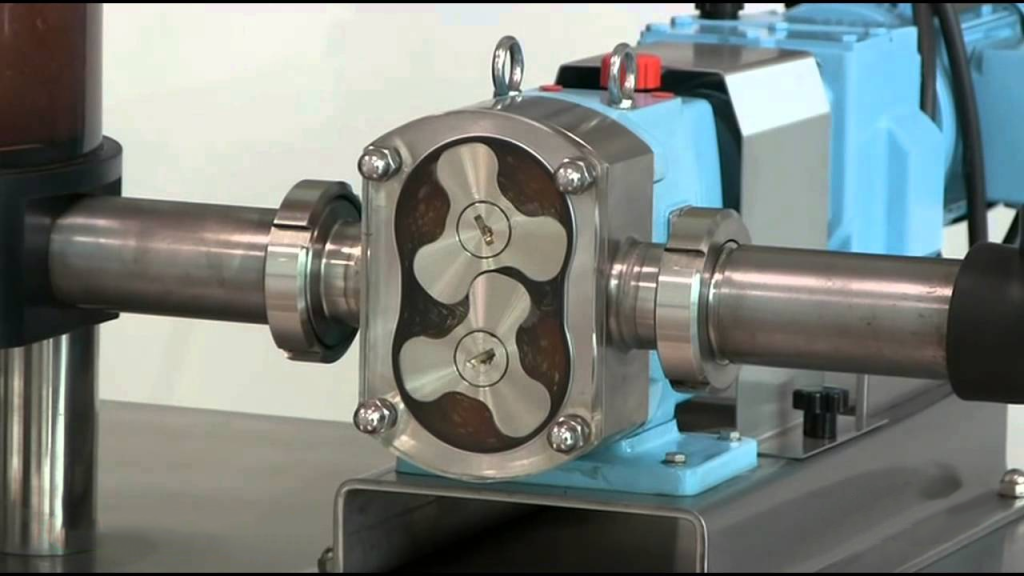
Choosing a pump for viscous food products is a technological task that determines the quality of raw materials, line productivity, and energy consumption. Incorrect selection leads to product overheating, structural damage, equipment wear, and downtime. In this article, we will look at which pumps are most effective for pumping tomato paste, chocolate, minced meat, cheese curds and other viscous media, and provide clear engineering criteria for selection.
1. Key parameters: what is a ‘viscous product’ for a pump?
Before selecting a pump for viscous products, it is necessary to quantitatively assess the properties of the medium:
- Viscosity (dynamic, mPa·s, or kinematic, cSt). The type and power of the pump depend on this parameter.
- Up to 500 cSt (milk, juices): conventional centrifugal pumps can be used.
- 500 – 5,000 cSt (cream, honey, low-concentration tomato paste): volumetric pump zone (screw, gear).
- Over 10,000 cSt (thick pastes, chocolate, minced meat): exclusively volumetric pumps, often with jacket heating.
- Shear sensitivity. Does the structure break down under mechanical stress? For example, this is critical for delicate creams or yoghurts.
- Presence of solid inclusions. Minced meat, pasta with skin, pureed fruit — require a separate design of working mechanisms.
- Temperature control. Is heating/cooling of the jacket necessary to maintain fluidity (chocolate, fats)?
2. Comparison of pumps for viscous products: advantages and disadvantages
For effective pumping of viscous food products, volumetric pumps are mainly used. Let's take a look at the main types.
2.1. Screw (screw) pumps – the most versatile choice
Ideal for: products with variable and very high viscosity, sensitive to shear, and with solid inclusions.
- Products: high-concentration tomato paste, minced meat, dough, cheese/curd masses, fruit purees with pieces.
- Working principle: Smooth movement of the product in a closed cavity between the rotor and stator.
- Advantages:
- Careful transfer: minimal displacement and destruction of the structure.
- Excellent self-priming: can operate on ‘dry suction’.
- Flexibility: effective operation across a wide viscosity range (from 1 to 1,000,000 cSt).
- Disadvantages:
- Working pressure limitations.
- The stator (rubber or polymer) is a consumable part that needs to be replaced.
2.2. Gear pumps (external gear) – for homogeneous viscous media
Ideal for: homogeneous, viscous products without abrasive or large solid inclusions.
- Products: melted chocolate, glaze, melted fats and oils, condensed syrups, honey, peeled tomato paste.
- Principle of operation: Movement of fluid in the recesses between the teeth of two gears.
- Advantages:
- Compactness and high performance.
- Stable, uniform flow without pulsations (important for dosing).
- Ability to work with high temperatures (heating jacket available).
- Disadvantages:
- Sensitive to hard inclusions and dry operation – may lead to gear failure.
- Limited self-priming capacity compared to screw pumps.
2.3. Rotary vane pumps – for medium viscosity products
Suitable for: plastic, delicate masses of medium viscosity.
- Products: cream, yoghurt, margarine, cheese spreads, sauces.
- Advantages: More economical than gear-driven, adjustable performance.
- Disadvantages: Blades are a wearable part and are not recommended for products with solid particles.
2.4. Piston/plunger pumps – for precise dosing of viscous products
Application: high-precision dosing and filling of highly viscous pastes, minced meat, dough under high pressure.
Why are conventional centrifugal pumps not suitable? As viscosity increases, their efficiency (efficiency factor) drops sharply, the required power increases, and productivity decreases. For products with a viscosity of more than 500-1000 cSt, their use is economically and technologically unjustified.
For accurate selection of a pump for your viscous products, we recommend consulting with Steiner Ukraine engineers.
3. Other critical engineering factors when choosing
- Materials: Contact parts – AISI 316L stainless steel. Seals and parts (screw pump stators) – food-grade rubbers (NBR, EPDM, FKM) or polymers resistant to fats and temperatures.
- Drive and power: For very viscous products, you need a motor with power reserve and a gearbox that provides low speed (partially rpm).
- Heating/cooling: Jacket on the body for product thermostabilisation.
- Ease of maintenance (CIP/SIP): Quick disassembly for cleaning and replacement of worn parts.
Conclusion: Screw or gear pumps are often the best choice for pumping viscous food products. Screw pumps are used for media with inclusions and variable viscosity, while gear pumps are used for homogeneous, thermally stable products where uniform flow is important.
The most accurate selection method is calculation and testing. Steiner Ukraine specialists help to perform engineering calculations of power and performance to ensure that the pump meets the technological requirements.
Conclusion: The choice of pump for viscous food products is based on accurate data on viscosity, product structure and process line parameters. Investing in the right equipment pays off in terms of preserving raw material quality, reducing energy costs and avoiding downtime.
For calculation, selection and organisation of pump testing for your viscous products, please contact the engineering department of Steiner Ukraine. We offer solutions from leading European manufacturers and full support.